

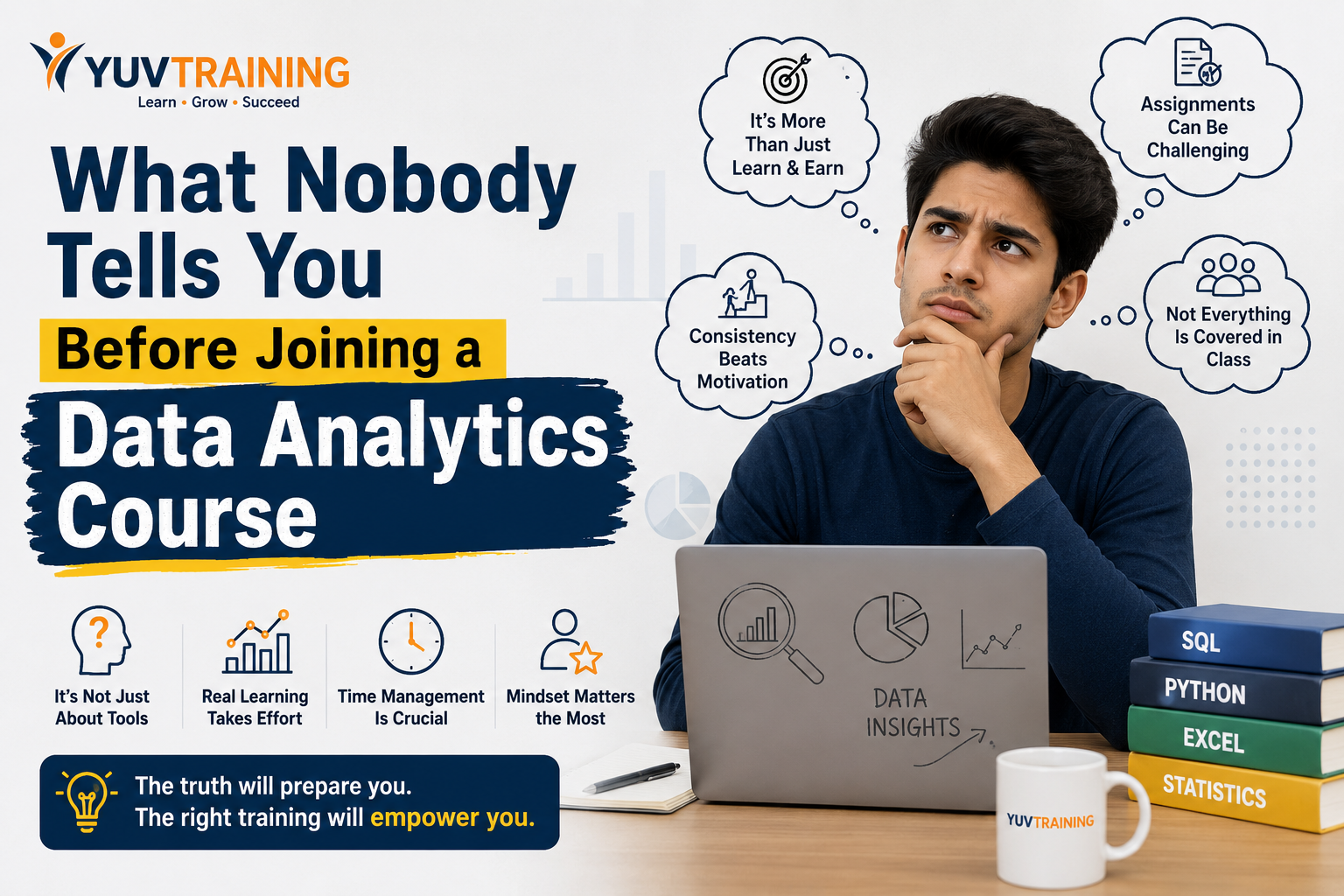
Scroll through LinkedIn or YouTube for just five minutes, and you’ll probably come across headlines like “Become a Data Analyst in 3 Months”, “Earn ₹10 LPA Without Coding”, or “Get Placed in Top MNCs Easily.”
It sounds exciting, doesn’t it?
But here’s the reality—data analytics is an amazing career, but it’s not magic. While there are incredible opportunities, there are also a few things that most advertisements and promotional videos don’t talk about.
If you’re planning to enroll in a data analyst course, this blog will give you a realistic picture of what to expect. Knowing these truths beforehand can save you time, money, and unnecessary frustration.
Let’s dive into the things nobody tells you before joining a data analytics course.
Data Analytics Is More About Thinking Than Coding
One of the biggest myths is that data analytics is all about programming.
The truth?
Coding is just one part of the job.
A good data analyst spends more time asking questions like:
- Why did sales suddenly drop?
- Which customers are likely to leave?
- What product performs best?
- Which marketing campaign generated the highest ROI?
Tools like Excel, SQL, Power BI, and Python help answer these questions, but the real skill is analytical thinking.
If you enjoy solving puzzles and finding patterns, you’re already moving in the right direction.
Watching Videos Won’t Make You Job-Ready
Many beginners believe that completing video lectures means they’ve learned the skill.
Unfortunately, it doesn’t work that way.
Imagine learning to drive by only watching driving tutorials.
Sounds impossible, right?
The same applies to data analytics.
After every topic, you should practice by working on real datasets. The more you solve problems yourself, the more confident you’ll become.
Learning happens when your hands are on the keyboard—not just when you’re watching someone else’s screen.
Excel Is Still One of the Most Powerful Skills
Many students rush toward AI tools or Python without mastering Excel.
That’s a mistake.
Even in 2026, Excel remains one of the most commonly used tools in business.
Companies still rely on Excel for:
- Reporting
- Budget planning
- Sales analysis
- Inventory tracking
- Financial dashboards
- Data cleaning
Mastering formulas, Pivot Tables, XLOOKUP, charts, and dashboards gives you a strong foundation before moving to advanced tools.
SQL Is Not Optional Anymore
If someone tells you SQL isn’t important, don’t believe them.
Most business data is stored inside databases.
Without SQL, accessing and analyzing that data becomes difficult.
This is why every quality data analyst course includes SQL as a core module.
Learning SQL early makes dashboard creation, reporting, and business analysis much easier.
Understanding Databases Gives You an Advantage
Many beginners focus only on visualization tools.
However, experienced recruiters know that analysts who understand databases can solve more complex business problems.
A structured database analyst course helps you learn:
- Database concepts
- Data storage
- SQL joins
- Relationships between tables
- Data retrieval
- Query optimization
These skills become especially valuable when working with large datasets in real companies.
AI Is Changing Data Analytics—Not Replacing Analysts
This is probably the biggest concern students have today.
“Will AI replace data analysts?”
The answer is more interesting than you might expect.
AI can generate charts, write SQL queries, and automate repetitive tasks.
But businesses still need professionals who can:
- Understand business objectives
- Verify AI-generated insights
- Interpret results correctly
- Explain findings to stakeholders
- Recommend business decisions
Instead of replacing analysts, AI is becoming a powerful assistant.
The smartest professionals are learning how to work with AI rather than compete against it.
Projects Matter More Than Certificates
Here’s something recruiters rarely say publicly.
A candidate with five strong projects often gets shortlisted before someone with ten certificates.
Projects show that you can apply your knowledge in real-world situations.
Some excellent beginner who has done data analyst course, projects include:
- Sales Dashboard
- Customer Churn Analysis
- HR Analytics Dashboard
- E-commerce Sales Report
- IPL Data Analysis
- Netflix Dataset Analysis
- Marketing Campaign Performance Dashboard
Every project improves your confidence and strengthens your resume.
Communication Is a Hidden Superpower
Many people think analysts only work with numbers.
Actually, they spend a lot of time explaining those numbers.
Imagine creating an amazing dashboard but being unable to explain what it means.
Business leaders won’t benefit from it.
Good communication helps you:
- Present reports confidently
- Explain trends clearly
- Recommend business actions
- Collaborate with different teams
This soft skill often separates average analysts from exceptional ones.
Learning Never Really Stops
Technology evolves quickly.
A few years ago, Power BI wasn’t as popular.
Today, it’s one of the most requested skills.
Now companies are also exploring:
- AI-powered analytics
- Microsoft Fabric
- Cloud data platforms
- Real-time dashboards
- Automated reporting
- Predictive analytics
The best analysts continuously update their skills instead of relying only on what they learned during training.
Placement Depends on Your Effort Too
Many students expect a course alone to guarantee a job.
A training institute can provide guidance, mentorship, projects, interview preparation, and placement support.
But success also depends on:
- Daily practice
- Portfolio quality
- Resume
- Mock interviews
- Communication skills
- Consistency
Students who complete their data analyst course and actively practice outside class usually perform much better during interviews.
Build Your Portfolio Before You Start Applying
Your portfolio is your proof of skill.
Instead of simply writing “Power BI” or “SQL” on your resume, show employers what you’ve built.
Include:
- Interactive dashboards
- SQL projects
- Excel reports
- GitHub repositories
- Power BI portfolio
- Business case studies
Recruiters love candidates who can demonstrate practical experience.
Don’t Compare Your Journey With Others
One student may get a job in two months.
Another may take six months.
Someone else may already have experience in finance or business, making their transition easier.
Everyone starts from a different point.
Instead of comparing yourself, focus on improving one skill every week.
Consistency beats speed.
Questions You Should Ask Before Joining Any Course
Before enrolling, don’t just look at the fees.
Ask questions like:
- Does the course include live projects?
- Will I build a portfolio?
- Is SQL taught properly?
- Are Power BI and Excel covered in depth?
- Is interview preparation included?
- Are industry case studies part of the curriculum?
- Is placement assistance available?
- Will I receive guidance on resume building?
The answers will tell you much more than any flashy advertisement.
Final Thoughts
Joining a data analyst course can open the door to one of the fastest-growing careers today—but only if you approach it with the right expectations.
Success doesn’t come from collecting certificates. It comes from practicing consistently, building real projects, learning SQL, understanding business problems, and staying curious as the industry evolves.
Adding knowledge through a database analyst course can further strengthen your technical foundation, making you more confident when working with databases and large-scale business data.
The biggest secret nobody tells you? Becoming a data analyst isn’t about being the smartest person in the room—it’s about being the person who’s willing to learn, practice, and improve every single day.
If you stay consistent, keep building projects, and embrace new technologies like AI instead of fearing them, you’ll be well on your way to building a rewarding career in d
To get more information visit our campus:YuvTrainings | Skill Development Training Institute