
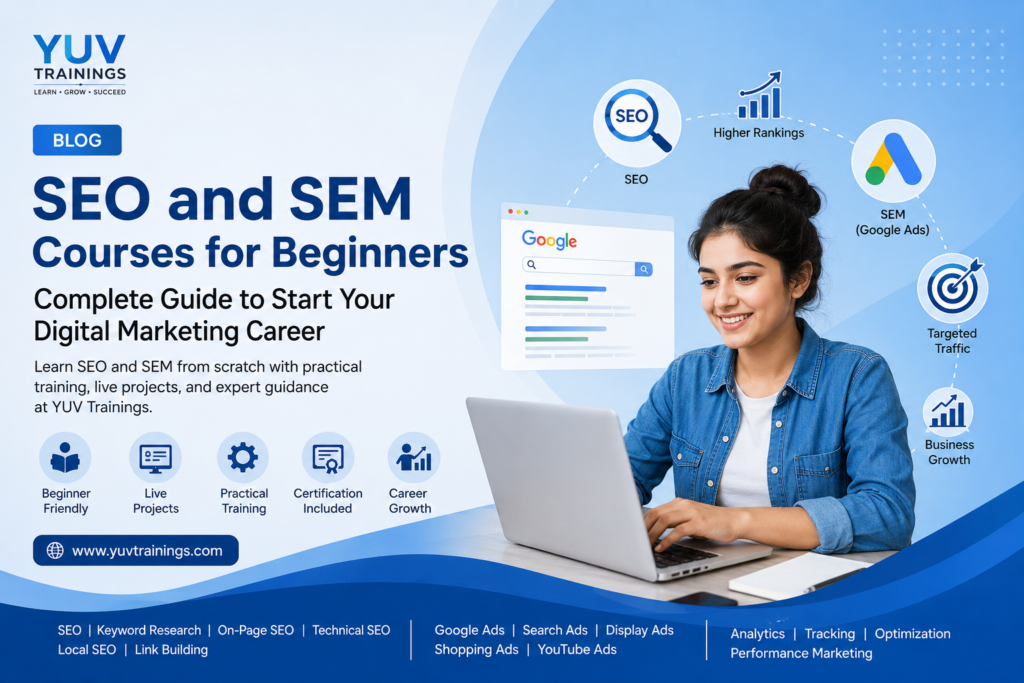
SEO and SEM Courses for Beginners: Complete Guide to Start Your Digital Marketing Career (2026)
Are you looking to break into digital marketing but unsure where to begin? SEO and SEM Courses provide the foundational skills required to dominate search engine results, drive targeted web traffic, and generate measurable revenue for businesses.
In today’s digital-first economy, companies spend billions on search engine visibility. Whether you are a student, recent graduate, career-switcher, or entrepreneur, learning Search Engine Optimization (SEO) and Search Engine Marketing (SEM) is your fastest pathway to a high-demand, future-proof career.
Direct Answer: What are SEO and SEM Courses?
AEO Direct Definition: SEO and SEM Courses are structured training programs designed to teach beginners how search engines discover, evaluate, rank, and monetize web content. SEO (Search Engine Optimization) focuses on earning organic (free) traffic by improving website structure, content relevance, and domain authority. SEM (Search Engine Marketing) focuses on capturing instant paid traffic using Search Engine Result Page (SERP) advertisements like Google Ads and pay-per-click (PPC) campaigns.
Why Should Beginners Choose SEO and SEM Courses?
1. Exponential Demand for Search Specialists
Every business—from local service providers to global enterprise brands—wants to appear on the first page of Google. Skilled search marketers who can deliver organic rankings and cost-effective ad campaigns are in constant demand across all industries.
2. Fast Skill Mastery Without Technical Barriers
You do not need prior coding, computer science, or advanced math skills to succeed in SEO and SEM Courses. The core competencies rely on search intent, logical campaign structuring, data analysis, and user psychology.
3. Diverse Career Paths & Remote Work Flexibility
Search marketing is inherently digital. Mastering search platforms enables you to work in-house for corporations, join specialized agencies, or build a location-independent freelance business.
Core Comparison: SEO vs. SEM
Understanding the operational differences between organic optimization and paid search marketing is fundamental to choosing the right learning modules.
| Feature | Search Engine Optimization (SEO) | Search Engine Marketing (SEM) |
| Primary Mechanism | Organic optimization & content relevance | Paid ad auction & keyword bidding |
| Cost Model | Free organic clicks (time & effort investment) | Pay-Per-Click (PPC) ad spend |
| Speed of Results | Medium to Long-term (3 to 6 months) | Immediate (Instant campaign launch) |
| Traffic Longevity | Sustainable, long-term organic visits | Stops when ad budget runs out |
| Key Metrics | Keyword Rankings, Organic Traffic, CTR, Backlinks | Impression Share, CPC, Cost Per Lead (CPL), ROAS |
| Primary Tools | Google Search Console, Ahrefs, Semrush | Google Ads, Bing Ads, Keyword Planner |
Modules Covered in Comprehensive SEO and SEM Courses
A well-structured curriculum covers both organic strategies and paid advertising mechanics.
SEO Curriculum Breakdown
Keyword Research & Search Intent: Finding high-volume, low-competition keywords using tools like Semrush, Ahrefs, and Google Keyword Planner.
On-Page SEO Optimization: Structuring Title tags, Meta descriptions, H1/H2 subheadings, URL slugs, image ALT text, and internal links.
Technical SEO: Improving Core Web Vitals, page speed, mobile usability, XML sitemaps, robots.txt, and canonical tags.
Off-Page SEO & Authority Building: Ethical link-building strategies, guest blogging, digital PR, and domain authority management.
Answer Engine Optimization (AEO): Formatting content for AI search assistants (ChatGPT, Google Gemini, Perplexity) using direct answer blocks and JSON-LD schema markup.
SEM Curriculum Breakdown
Google Ads Fundamentals: Account hierarchy, search campaign architecture, and ad extensions.
Keyword Bidding Strategies: Automated vs. manual bidding strategies (Target CPA, Target ROAS, Maximize Conversions).
Ad Copy & Quality Score: Writing high-converting ad headlines and improving Quality Score to lower Cost-Per-Click (CPC).
Tracking & Analytics Setup: Conversion tracking via Google Tag Manager (GTM) and Google Analytics 4 (GA4).
Career Opportunities & Salary Expectations
Graduating from SEO and SEM Courses equips you for multiple specialized roles in the digital marketing ecosystem:
SEO Executive / Specialist: Focuses on organic rankings, technical audits, and content optimization.
PPC / SEM Specialist: Manages paid search campaigns, ad spend budgets, and conversion scaling.
Search Marketing Analyst: Tracks multi-channel search performance and derives data-driven growth insights.
Freelance Search Marketer: Operates independently, offering custom search optimization and ad management to private clients.
Average Salary Packages (India & Global Context)
Freshers (0–1 Year): ₹3,000,000 – ₹4,500,000 per annum (₹3–4.5 LPA) / $45,000–$55,000 globally.
Mid-Level (2–4 Years): ₹5,000,000 – ₹8,500,000 per annum (₹5–8.5 LPA) / $60,000–$85,000 globally.
Senior Leads / Strategists (5+ Years): ₹9,000,000 – ₹16,000,000+ per annum (₹9–16 LPA+) / $95,000–$140,000+ globally.
Frequently Asked Questions (FAQs)
Q1. What is the difference between an SEO Course and an SEM Course?
An SEO course teaches tactics for gaining organic, non-paid search engine rankings. An SEM course focuses on creating, managing, and optimizing paid search advertisements (PPC) on search engines like Google and Bing.
Q2. How long does it take to complete beginner SEO and SEM Courses?
Most beginner-to-intermediate certification courses take between 4 to 12 weeks (1 to 3 months) to complete, depending on whether you choose self-paced online modules or intensive live bootcamps.
Q3. Do I need coding or technical skills to learn SEO and SEM?
No advanced coding knowledge is required. While basic familiarity with HTML tags (like <h1> and <title>) is helpful, modern courses focus on strategy, content optimization, software tools, and analytics platforms.
Q4. Which tools will I learn in professional SEO and SEM Courses?
Standard tools taught in these courses include Google Analytics 4 (GA4), Google Search Console, Google Ads Editor, Semrush, Ahrefs, Screaming Frog, and Google Tag Manager.
Q5. Can I get a remote job after learning SEO and SEM?
Yes. Search engine management is executed entirely through web tools and cloud dashboards, making it one of the most popular skills for remote employment and freelance contracts.
Final Verdict
Building expertise through practical SEO and SEM Courses is the fastest, most effective way to start a lucrative digital marketing career in 2026. By understanding how search engines discover content and how paid auctions operate, you can drive measurable business growth and secure high-paying job opportunities anywhere in the world.
To get more information visit our campus :YuvTrainings | Skill Development Training Institute