

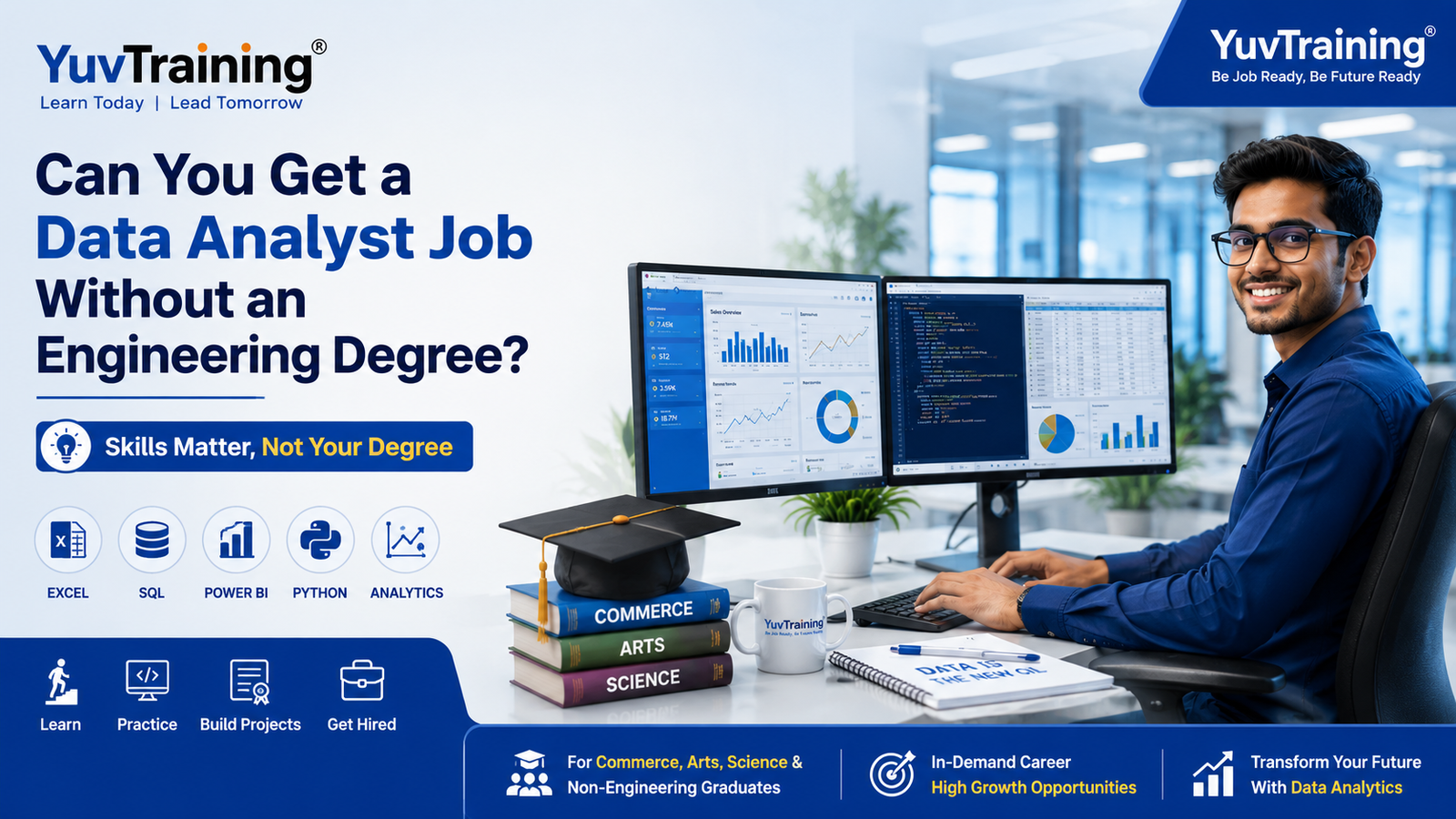
The demand for data analysts is growing faster than ever. Every business today—from startups to multinational companies—relies on data to make better decisions. This has created thousands of job opportunities, and one question keeps coming up among students and working professionals:
“Can I become a data analyst without an engineering degree?”
The short answer is Yes.
In 2026, companies are focusing more on skills, practical projects, and problem-solving ability than on whether you have an engineering background. If you know how to work with data and can demonstrate your skills, your degree often becomes secondary.
Let’s understand why.
Why Data Analytics Has Become One of the Most In-Demand Careers
Every click, purchase, search, and online interaction creates data. Businesses use this information to understand customer behavior, improve products, increase sales, and reduce costs.
This is where data analysts come in.
A data analyst collects, cleans, analyzes, and presents data in a way that helps businesses make informed decisions. Whether it’s an e-commerce company tracking customer purchases or a hospital analyzing patient records, data analysts play a crucial role.
Because every industry needs data professionals, opportunities are available across:
- IT Companies
- Banking & Finance
- Healthcare
- E-commerce
- Marketing Agencies
- Manufacturing
- Education
- Government Organizations
- Startups
The best part? Many of these companies hire candidates from commerce, science, arts, management, and other non-engineering backgrounds.
Do Companies Really Require an Engineering Degree?
A few years ago, engineering graduates had an advantage because they were already familiar with technical concepts.
But the hiring landscape has changed significantly.
Today, recruiters look for candidates who can:
- Analyze data effectively
- Work with Excel and SQL
- Build dashboards
- Use Power BI or Tableau
- Perform basic statistical analysis
- Communicate insights clearly
If you possess these skills, your educational background becomes much less important.
Many successful data analysts today come from backgrounds like:
- B.Com
- BBA
- B.Sc.
- BA
- MBA
- Economics
- Mathematics
- Commerce
- Even professionals switching careers from sales, HR, or customer support
Skills Matter More Than Your Degree
Instead of worrying about your degree, focus on building practical skills.
Some of the most important skills include:
Microsoft Excel
Excel remains one of the most widely used tools for data analysis. Learning formulas, Pivot Tables, charts, dashboards, and data cleaning techniques is essential.
SQL
SQL helps you retrieve and manage data stored in databases. Almost every data analyst role requires SQL knowledge.
Power BI or Tableau
Visualization tools help convert complex datasets into interactive dashboards that decision-makers can easily understand.
Python (Optional but Highly Recommended)
Python makes data cleaning, automation, and advanced analytics much easier.
Statistics
You don’t need advanced mathematics, but understanding averages, probability, distributions, and trends helps in making better business decisions.
Build Projects Instead of Just Collecting Certificates
One mistake many beginners make is collecting certificates without gaining practical experience.
Recruiters are much more interested in seeing projects like:
- Sales Dashboard
- HR Analytics Dashboard
- Customer Segmentation Analysis
- Netflix Data Analysis
- IPL Data Analysis
- E-commerce Sales Dashboard
- Financial Performance Dashboard
Projects prove that you can solve real business problems.
Certifications Can Boost Your Profile
A well-structured data analyst course helps beginners learn industry-relevant tools in the correct sequence while working on practical projects.
Instead of learning random topics from multiple sources, a structured course provides:
- Step-by-step learning
- Live projects
- Industry case studies
- Portfolio building
- Interview preparation
- Resume guidance
This makes it easier to transition into the field even without an engineering degree.
Understanding Databases Is Also Important
Many companies expect analysts to work with databases every day.
A good database analyst course helps learners understand:
- Database fundamentals
- SQL queries
- Data retrieval
- Data management
- Database optimization
- Real-world database projects
Strong database skills make your profile more attractive because businesses store most of their data in databases.
What Recruiters Look for in 2026
Hiring trends have evolved significantly.
Today recruiters value candidates who can demonstrate:
- Practical projects
- Strong SQL knowledge
- Dashboard-building skills
- Business understanding
- Communication skills
- Problem-solving ability
- Portfolio on GitHub or Power BI
- Continuous learning mindset
Many companies even conduct skill-based assessments instead of focusing heavily on academic qualifications.
How Freshers Can Get Their First Data Analyst Job
Breaking into the field becomes much easier if you follow the right roadmap.
Step 1: Learn the Fundamentals
Start with Excel, SQL, statistics, and Power BI.
Step 2: Practice Every Day
Spend at least one hour daily working with datasets instead of only watching tutorials.
Step 3: Create Real Projects
Develop dashboards and analytics reports using publicly available datasets.
Step 4: Build an Online Portfolio
Upload your projects to GitHub or create a Power BI portfolio.
Step 5: Optimize Your Resume
Highlight your skills, projects, certifications, and achievements instead of only listing educational qualifications.
Step 6: Apply Consistently
Apply through LinkedIn, company career pages, job portals, and referrals.
Common Myths About Becoming a Data Analyst
Myth 1: Only Engineers Can Become Data Analysts
Reality: Companies hire candidates from various educational backgrounds.
Myth 2: You Must Be Excellent at Mathematics
Reality: Basic statistics and logical thinking are usually enough for entry-level roles.
Myth 3: Coding Is Mandatory
Reality: Many beginner roles primarily require Excel, SQL, and Power BI. Python becomes useful as you advance.
Myth 4: You Need Years of Experience
Reality: A strong portfolio with practical projects can help freshers secure interviews.
Salary Expectations
Data analyst salaries vary depending on skills, location, and company.
Approximate salary ranges in India (2026):
- Freshers: ₹4 LPA – ₹7 LPA
- 2–4 Years Experience: ₹7 LPA – ₹12 LPA
- Experienced Analysts: ₹12 LPA – ₹20+ LPA
Professionals with expertise in SQL, Power BI, Python, and cloud analytics often receive higher salary packages.
Is This Career Future-Proof?
Absolutely.
With the rise of Artificial Intelligence (AI), automation, and business intelligence, companies are generating more data than ever before.
While AI can automate repetitive tasks, businesses still need skilled professionals who can:
- Understand business problems
- Interpret data correctly
- Build meaningful dashboards
- Present actionable insights
- Support strategic decision-making
This makes data analytics one of the most promising career choices for the coming years.
Final Thoughts
So, can you get a data analyst job without an engineering degree?
Yes—you absolutely can.
Your success depends far more on your skills, projects, and ability to solve business problems than on your academic background. Whether you’re a B.Com, BBA, BA, B.Sc., MBA, or a working professional planning a career switch, data analytics offers exciting opportunities if you’re willing to learn and practice consistently.
A structured data analyst course can help you master the essential tools and build a job-ready portfolio, while a database analyst course strengthens your understanding of SQL and databases—two skills that employers actively seek.
The future belongs to professionals who can turn data into meaningful insights. If you’re ready to learn, practice, and stay updated with industry trends, there’s no reason an engineering degree should hold you back.
To get more information visit our campus:YuvTrainings | Skill Development Training Institute
Lorem ipsum dolor sit amet, consectetur adipiscing elit. Ut elit tellus, luctus nec ullamcorper mattis, pulvinar dapibus leo.