
Introduction
Choosing the right career path after graduation is one of the biggest decisions for students and young professionals. As businesses rapidly shift budgets from traditional print and TV channels to search engines, social media platforms, and AI-driven growth systems, marketing has fundamentally evolved. Today, almost every industry relies heavily on digital marketing to attract, engage, and convert modern consumers.
This massive industry transformation leaves aspirants facing a crucial debate: Digital Marketing Course vs MBA in Marketing: Which is Better?
Should you invest two years and a substantial financial budget into a traditional Master of Business Administration (MBA) in Marketing? Or should you take a specialized, fast-track digital marketing course that equips you with live tool experience, performance media skills, and real-world project portfolios in just a few months?
Understanding the detailed differences between these two qualifications is vital for your career trajectory in 2026. While an MBA in Marketing focuses on macro-level business administration, consumer psychology, corporate finance, and long-term brand strategy, a professional digital marketing course delivers hands-on, channel-specific execution—including Search Engine Optimization (SEO), Search Engine Marketing (SEM/PPC), Meta Ads, Google Analytics 4 (GA4), and automated CRM funnels.
In this complete 2026 career guide, Yuvtrainings provides an in-depth breakdown of both educational tracks, comparing their syllabi, costs, learning mechanics, time-to-market speed, salary outcomes, and long-term growth potential to help you make an informed decision.
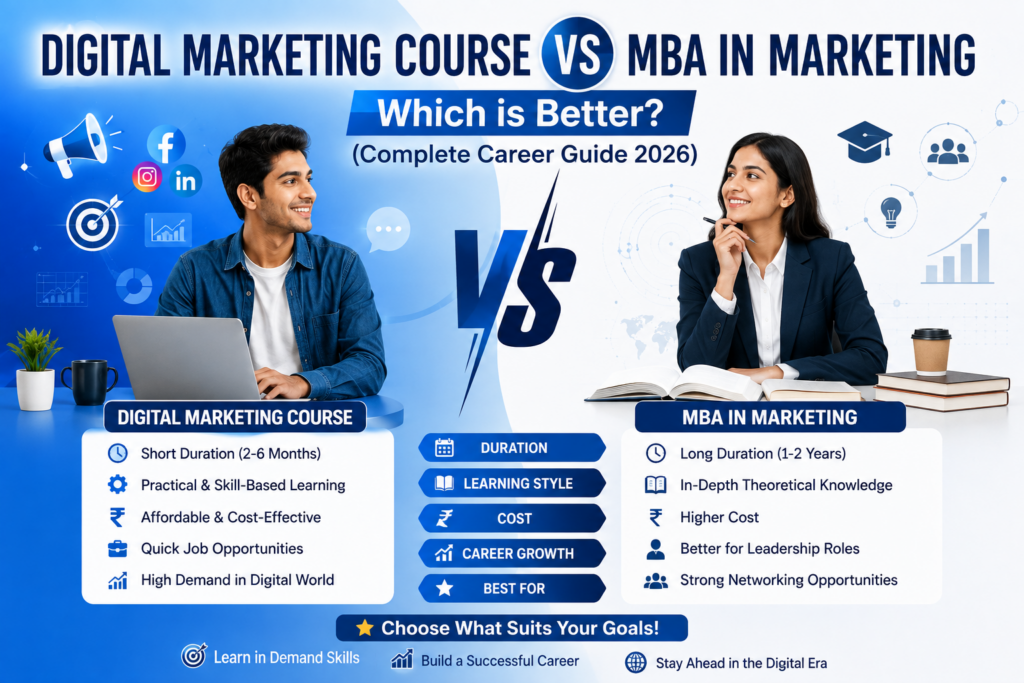
Quick Comparison: Digital Marketing Course vs. MBA in Marketing
Comparison Parameter | Digital Marketing Course (Specialized Certification) | MBA in Marketing (Postgraduate Degree) |
Primary Focus | Technical execution, campaign performance, hands-on tools, growth marketing, live ROI tracking | Macro business strategy, managerial leadership, corporate finance, market research, brand building |
Program Duration | 3 to 6 Months | 2 Years (Full-time) |
Average Course Fee | ₹25,000 – ₹1,500,000 (Very High ROI) | ₹400,000 – ₹2,500,000+ |
Eligibility Criteria | Open to 10+2 students, graduates, job seekers, freelancers, and entrepreneurs | Bachelor’s Degree + Competitive Entrance Exams (CAT, MAT, XAT, GMAT) |
Learning Methodology | Practical, live ad budgets, real website optimization, campaign analytics | Case studies, theoretical frameworks, academic research, corporate management lectures |
Time to Market | Immediate (Job-ready or taking freelance clients in 3 to 6 months) | Delayed (2-year full-time academic commitment) |
Ideal Candidate | Action-oriented learners, career pivoters, performance marketers, agency aspirants | Corporate management aspirers, FMCG brand managers, executive leadership candidates |
What is a Digital Marketing Course?
A specialized digital marketing course is a skill-focused, short-term training program designed to teach practical, channel-specific promotion. Instead of spending months analyzing theoretical management models, these bootcamps prioritize immediate execution, tool fluency, and modern marketing technology stacks.
DIGITAL MARKETING COURSE CORE FOCUS
│
┌────────────────┬──────────┴──────────┬────────────────┐
▼ ▼ ▼ ▼
[ Search & SEO ] [ Paid Media ] [ Content & Copy [ Data Analytics ]
Organic Ranking Meta/Google Ads Growth Storytelling GA4 & ROI Metrics
Key Highlights & Strengths:
- Tool & Dashboard Mastery: Direct exposure to platforms like Google Analytics 4 (GA4), Meta Ads Manager, Semrush, Google Search Console, Mailchimp, and AI marketing tools.
- Skill-First Approach: Focuses on lead generation, conversion rate optimization (CRO), keyword research, and measurable campaign ROI.
- Rapid Portfolio Building: Programs offered by industry-focused platforms like Yuvtrainings allow learners to build live project portfolios and apply for specialized jobs within months.
What is an MBA in Marketing?
An MBA in Marketing is a traditional 2-year postgraduate degree program that offers a broad overview of business management. It treats digital marketing as one pillar within a larger corporate structure alongside finance, human resources, supply chain management, and corporate operations.
MBA IN MARKETING CORE FOCUSE
┌───────────────┴┬──────────────────┬───────────┐
▼ ▼ ▼ ▼
[ Brand Strategy ] [ Consumer Psychology ] [ Market Research ] [ Corporate Finance ]
Overall Positioning Buyer Decisions Data & Profiling P&L Responsibility
Key Highlights & Strengths:
- Strategic & Managerial Depth: Emphasizes classic corporate frameworks like the 4 Ps of Marketing, Porter’s Five Forces, and market segmentation.
- Leadership Development: Prepares graduates for team management, cross-functional collaboration, corporate budgeting, and high-level client relations.
- Placement Networks: Top-tier B-schools provide campus recruitment drives connecting students with corporate houses, MNCs, and FMCG brands.
Deep Dive: 5 Critical Factors for 2026 Aspirants
1. Skill Relevance & Adaptability
The digital marketing sector changes rapidly. Search algorithms, ad platforms, tracking regulations, and AI automation tools shift frequently.
- Digital Marketing Course: Syllabi adapt quickly to incorporate real-time algorithm shifts, AI workflow integrations, and new ad channels.
- MBA in Marketing: University curricula update on slower academic cycles. While foundational consumer behavior theories remain timeless, specific tactical tools taught in MBA classes can lag behind modern agency practices.
2. Time Investment & Opportunity Cost
- Digital Marketing Course: Requires 3 to 6 months. A lower opportunity cost allows you to enter the workforce, begin freelancing, or launch campaigns without spending years in school.
- MBA in Marketing: Demands a full 2-year commitment. You forego two full years of full-time work experience and income while paying tuition fees.
3. Financial Investment & ROI
TIME-TO-EARN & COST RATIO:
Digital Marketing Course [███] Low Investment (~3-6 Months to Earn)
MBA in Marketing [████████████████████] High Investment (24 Months to Earn)
- Digital Marketing Course: High Return on Investment (ROI). A modest financial outlay gives you skills that qualify you for specialist job roles, client freelancing, or business growth.
- MBA in Marketing: Involves substantial capital. Recovering a large tuition investment can take several years unless you graduate from a top-tier business school.
4. Practical Execution vs. High-Level Strategy
- Digital Marketing Course: Focused on direct application—setting up live ad campaigns, optimizing landing page SEO, running A/B tests, and tracking conversion goals.
- MBA in Marketing: Focused on strategic analysis—evaluating business case studies, presenting high-level brand pitches, and understanding corporate P&L metrics.
Job Roles & Career Opportunities
Careers After a Digital Marketing Course
Specializing through a practical digital marketing program allows you to enter the market as an execution specialist or growth marketer:
- SEO & Content Specialist: Managing organic rankings and web content strategy.
- Performance Marketing Executive: Running paid campaigns on Google Ads, Meta, and LinkedIn.
- Social Media & Community Manager: Driving brand engagement across social channels.
- Marketing Automation & Email Specialist: Integrating CRMs, email sequences, and lead capture funnels.
- Starting Salary Range: ₹3.5 LPA to ₹7.5 LPA (scales rapidly based on proven ROI, portfolio strength, and technical skills).
Careers After an MBA in Marketing
Completing a postgraduate degree usually points toward management-track and corporate roles:
- Brand Manager: Overseeing multi-channel brand positioning and communication budgets.
- Product Marketing Manager: Aligning product development with market positioning.
- Market Research & Insights Analyst: Analyzing consumer trends and competitive dynamics.
- Sales & Territory Manager: Directing retail distribution, trade channels, and sales teams.
- Starting Salary Range: ₹5 LPA to ₹18+ LPA (heavily dependent on campus tier and corporate recruitment partners).
Which Option Should You Pick?
WHICH PATH IS RIGHT FOR YOU?
│
┌─────────────────────────────┐
▼ ▼
[ Pick a Digital Marketing Course IF: ] [ Pick an MBA in Marketing IF: ]
- You want fast entry into the job market. • You hold a bachelor’s degree & aim for management.
- You prefer hands-on, tool-driven execution.• You have the budget for a top-tier B-school.
- You plan to freelance, consult, or start. • You want to manage FMCG or corporate brand strategy.
Choose a Digital Marketing Course IF:
- You want job-ready, practical skills without spending two full years in a traditional classroom.
- You want a cost-effective upskilling route that offers a fast financial return.
- You aspire to work as a performance marketer, open a digital agency, or grow your own business using online channels.
Choose an MBA in Marketing IF:
- You aim for executive corporate management or brand strategy roles in large corporate enterprises.
- You have the time, financial backing, and entrance scores to secure admission into a top-ranked business school.
- You want broad business training covering accounting, human resources, and operations alongside digital marketing principles.
Frequently Asked Questions (FAQs)
1. Digital Marketing Course vs MBA in Marketing: Which is Better for absolute beginners?
For beginners seeking quick entry into the industry, a digital marketing course is often better because it teaches practical, hands-on skills like SEO, PPC, and analytics in just 3 to 6 months. An MBA in Marketing is better suited for candidates aiming specifically for long-term corporate management roles.
2. Can I land a high-paying job with a Digital Marketing Course instead of an MBA?
Yes. Modern agencies, tech firms, and growth-stage startups prioritize practical portfolio results, tool mastery, and campaign performance over traditional degrees. Specialized digital marketing professionals who demonstrate clear campaign ROI can earn competitive salaries early in their careers.
3. Is a Digital Marketing Course useful alongside an MBA?
Completing a practical digital marketing course alongside or prior to an MBA gives you a distinct advantage. You gain both macro-level business strategy skills and practical execution capabilities, making you more versatile during job interviews.
4. Do I need a technical or coding background to succeed in a digital marketing course?
No. Modern marketing tools, search dashboards, and CMS platforms are designed for ease of use without coding. Success relies on strategic thinking, analytical curiosity, clear communication, and consistent practice.
Conclusion
When weighing a digital marketing course vs MBA in marketing, the best choice depends on your financial budget, learning style, and career timeline. If you want fast job readiness, hands-on tool mastery, and high ROI, taking a practical certification course is an effective step forward. If you aim for corporate executive management and overall brand leadership, an MBA remains a traditional, long-term pathway.
Ready to advance your career with practical, industry-aligned digital skills? Explore our job-oriented programs at Yuv trainings, or visit the official [Yuvtrainings Google Business Profile (GBP)] to check out student reviews, view upcoming course batches, and connect directly with our career counselors today!