

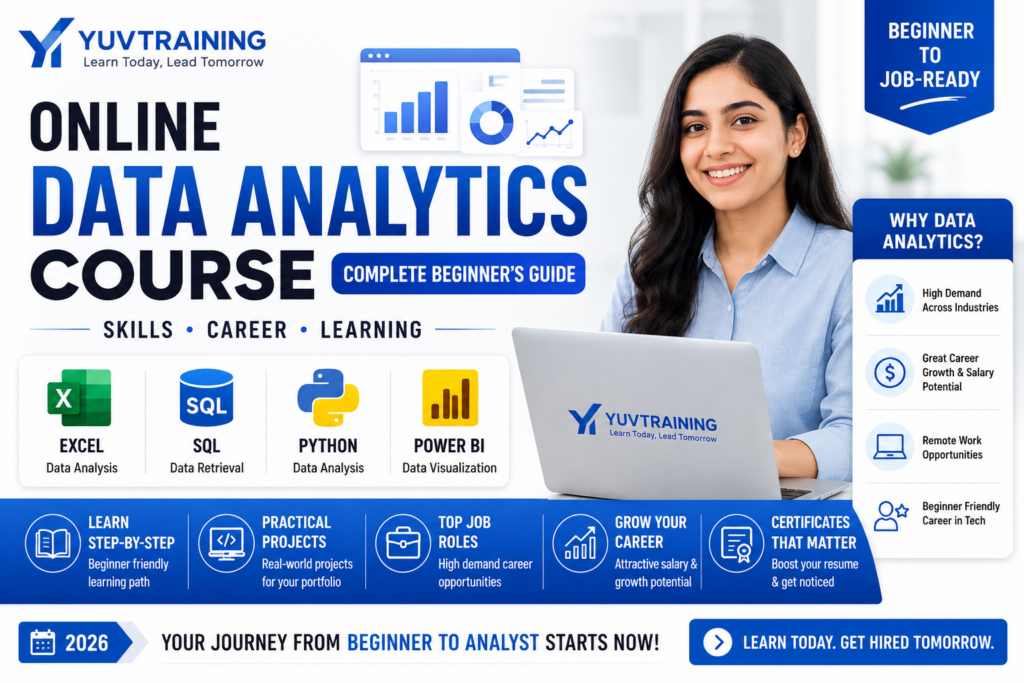
In today’s digital world, businesses generate and use huge amounts of data every day. From customer behavior and sales reports to website traffic and marketing performance, data plays an important role in business decision-making. An Online Data Analytics Course helps beginners learn how to collect, organize, analyze, and interpret this data to find useful insights. These courses generally cover essential skills such as Excel, SQL, statistics, data visualization, dashboards, and analytical thinking, along with practical projects that help learners understand real-world applications.
In 2026, Data Analytics has become a valuable skill across industries such as marketing, finance, e-commerce, banking, healthcare, retail, and technology. One of the biggest advantages of learning online is the flexibility to study at your own pace while developing practical, career-focused skills. Whether you are a student, graduate, working professional, or complete beginner, an Online Data Analytics Course can help you build a strong foundation and understand the skills, tools, career opportunities, and learning path required to enter the field of Data Analytics.
What Is an Online Data Analytics Course?
An online data analytics course is a structured learning program that teaches you how to work with data and find meaningful information from it. Instead of only learning theoretical concepts, students can learn how to clean data, analyze datasets, create reports, and present insights in an understandable way. Online learning also allows students to study from home and manage their learning according to their schedule.
A good course generally begins with the fundamentals of data analytics before introducing more advanced tools and techniques. Beginners can learn how datasets are structured, how information is collected, and why data needs to be cleaned before analysis. As they progress, they may learn how to work with spreadsheets, databases, visualization platforms, and programming tools.
The learning process can include topics such as Excel, statistics, SQL, data cleaning, data visualization, Power BI, Tableau, Python, and business analytics. These skills help learners understand how raw information can be transformed into meaningful insights.
For example, imagine an online store has thousands of customer orders. The raw dataset may contain customer names, product information, order dates, prices, locations, and quantities. A learner studying data analytics can use this information to identify the best-selling products, compare monthly sales, find high-performing locations, and understand customer purchasing patterns.
Therefore, an online data analytics course is not simply about learning software. It is about developing the ability to work with data, identify patterns, understand results, and communicate useful insights.
Why Should Beginners Learn Data Analytics?
Data is now used in almost every industry, including marketing, finance, e-commerce, healthcare, education, and technology. Companies need people who can understand data and help them identify trends and patterns. By taking an online data analytics course, beginners can develop analytical thinking and learn how businesses use data to solve real-world problems.
Data analytics has become an important skill because businesses across different industries increasingly depend on data to understand their performance and make informed decisions. Industries such as e-commerce, finance, marketing, healthcare, education, technology, retail, logistics, and manufacturing all generate and use data in different ways.
For beginners, learning data analytics can be a useful way to develop a combination of technical, analytical, and business skills. Instead of making decisions based only on assumptions, organizations can use data to understand what is happening and identify possible opportunities or problems.
For example, a marketing team may want to know which advertising campaign generated the most leads. A sales team may want to identify its best-performing products. An e-commerce company may want to understand why customers are abandoning their shopping carts. These are the types of questions where data analytics can provide useful insights.
What Can You Learn in an Online Data Analytics Course?
A comprehensive online data analytics course can cover several important concepts and tools that help beginners develop practical analytical skills. The exact syllabus can differ between training providers, but a well-structured program generally starts with fundamentals and gradually moves toward practical analysis.
Data Analytics Fundamentals
Beginners can first learn what data analytics means, why organizations use it, and how analysts work with information. This section may introduce descriptive, diagnostic, predictive, and prescriptive analytics.
Data Collection and Data Sources
Students can learn where business data comes from, including spreadsheets, databases, websites, surveys, applications, CRM systems, and other digital platforms. Understanding data sources is important because the quality and structure of the source can affect the analysis.
Excel for Data Analytics
Excel can help beginners understand how to organize and analyze datasets. Topics may include formulas, sorting, filtering, conditional formatting, Pivot Tables, Pivot Charts, and basic dashboards.
Statistics
Basic statistics helps learners understand numbers and identify patterns correctly. Topics can include mean, median, mode, percentages, range, standard deviation, probability, correlation, and data distribution.
SQL
SQL helps analysts retrieve and analyze information stored in databases. Students can learn concepts such as SELECT statements, filtering, grouping, aggregate functions, joins, and basic queries.
Data Cleaning
Raw data may contain duplicates, missing values, incorrect entries, and inconsistent formats. Learners can understand how to prepare datasets before performing analysis.
Data Visualization
Students can learn how to communicate information using charts, graphs, and dashboards. Choosing the appropriate visualization is important because different charts communicate different types of information.
Power BI and Tableau
Visualization and business intelligence tools such as Power BI and Tableau can help learners create interactive reports and dashboards. These tools can be particularly useful when presenting analytical findings to business teams.
Python for Data Analytics
Depending on the course level, students may also learn Python basics and libraries such as Pandas and NumPy. Python can help with data manipulation, repetitive tasks, and more advanced analysis.
By learning these areas step by step, students can understand the complete process of turning raw data into useful business insights.
Practical Learning and Projects
One of the most useful parts of learning data analytics is practical experience. Instead of simply memorizing definitions, learners can work with sample datasets and create dashboards, reports, and visualizations. Practical projects can help beginners understand how analytics is used in real business situations and can also give them work samples to discuss during internships or interviews.
Who Should Join an Online Data Analytics Course?
An online data analytics course can be useful for college students, fresh graduates, beginners interested in technology, business students, marketing professionals, and people looking to develop a new career skill. You do not necessarily need to be an advanced programmer to start learning the basics of data analytics. A willingness to learn numbers, logical thinking, and analytical concepts can be a good starting point.
How Can Data Analytics Help Your Career?
Developing data analytics skills can open the door to different types of analytical and business-related roles. However, completing a course alone does not guarantee a job. Career opportunities depend on a learner’s skills, education, practical experience, portfolio, interview performance, and the requirements of individual employers.
With suitable training and practical experience, learners can explore roles such as:
- Data Analyst
- Junior Data Analyst
- Business Analyst
- Reporting Analyst
- Marketing Analyst
- Sales Analyst
- Operations Analyst
- Business Intelligence Analyst
The exact responsibilities can differ from one organization to another.
Why Choose YUV Trainings for Learning?
YUV Trainings focuses on practical and career-oriented learning. For beginners interested in an online data analytics course, choosing a learning program that combines concepts with practical exercises can make the learning process easier to understand. Students can focus on developing useful skills rather than learning only theoretical definitions.
Frequently Asked Questions (FAQs)
1. What is an online data analytics course?
An online data analytics course is a training program that teaches learners how to collect, clean, analyze, visualize, and interpret data. It can help beginners understand how businesses use data to make informed decisions.
2. Is an online data analytics course suitable for beginners?
Yes. Many beginner-level programs are designed for learners with little or no previous experience. Students can start with basic concepts and gradually move toward practical data analysis skills.
3. Do I need a technical degree to learn data analytics?
No. A technical degree is not always required for a beginner-level data analytics course. Some professional beginner programs specifically state that no prior experience or degree is required.
4. What topics are covered in an online data analytics course?
The syllabus can vary, but common topics include data fundamentals, data cleaning, data analysis, data visualization, statistics, spreadsheets, SQL, dashboards, and practical projects. Some courses may also introduce programming languages such as R or Python.
5. Which tools can I learn in a data analytics course?
Depending on the course, learners may work with tools such as Microsoft Excel or Google Sheets, SQL, Power BI, Tableau, Python, R, and other analytics platforms. The exact tools depend on the course syllabus.
Conclusion
An online data analytics course can be a useful starting point for anyone who wants to understand data and develop practical analytical skills. With the right combination of tools, concepts, projects, and consistent practice, beginners can build a strong foundation for future learning and career opportunities. YUV Trainings can be considered by learners looking for structured, career-focused training in data analytics.