

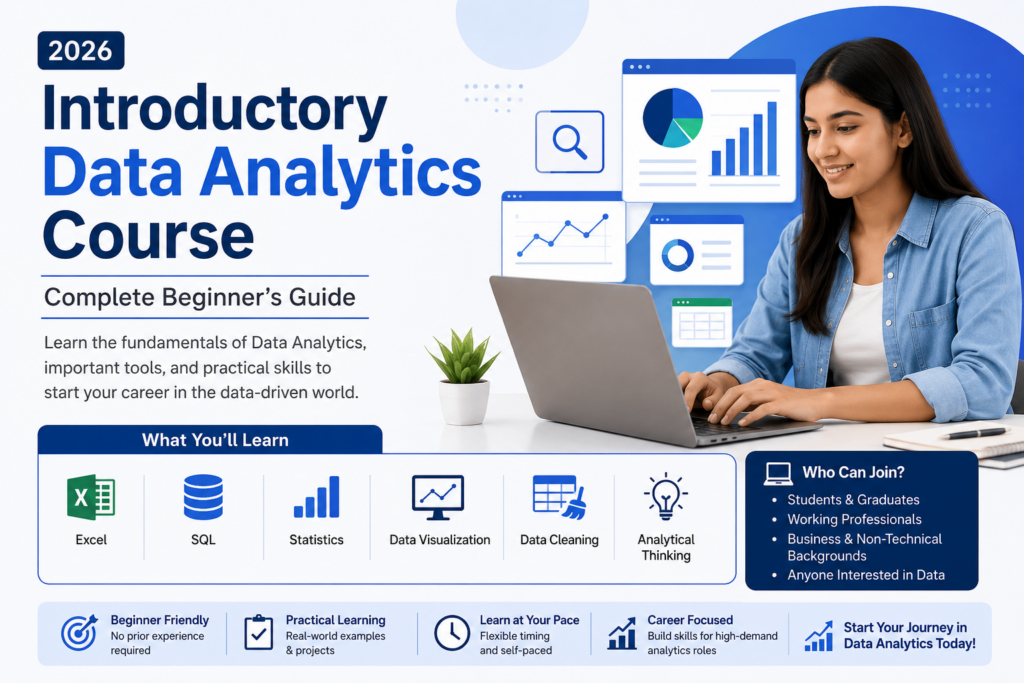
In today’s data-driven world, businesses rely heavily on data to understand customers, improve performance, identify trends, and make smarter decisions. An Introductory Data Analytics Course is designed for beginners who want to understand the fundamentals of data analytics without requiring advanced technical knowledge. It introduces learners to essential concepts such as data collection, data cleaning, basic statistics, Excel, data visualization, and analytical thinking, helping them understand how raw data can be converted into useful business insights.
Data has become an important part of almost every modern business. Companies use data to understand customers, track performance, identify trends, improve marketing campaigns, and make better business decisions. Because of this growing importance, learning the basics of data analytics can be a useful skill for students, beginners, and professionals from different backgrounds. An Introductory Data Analytics Course is designed to help learners understand the fundamentals of working with data without requiring an advanced technical background.
What Is an Introductory Data Analytics Course?
An Introductory Data Analytics Course is a beginner-friendly program that introduces learners to the basic concepts, tools, and techniques used to understand and analyze data. Instead of starting with complicated programming or advanced mathematics, an introductory course generally focuses on building a strong foundation. Learners can understand how raw data is collected, organized, cleaned, analyzed, visualized, and converted into useful insights. This makes a Beginner Data Analytics Course a suitable starting point for people who are completely new to analytics.
Why Should Beginners Learn Data Analytics?
Businesses generate large amounts of information through sales, websites, social media, customer interactions, marketing campaigns, and other activities. Simply having data is not enough; businesses need professionals who can understand what that information means. Data Analytics helps turn raw information into meaningful insights that can support better decisions. For example, a company can analyze sales data to identify its best-performing products, understand customer trends, or discover which months generate the highest revenue. Learning these concepts through a structured Data Analytics Course for Beginners can help students understand how data is used in real business situations.
What Do You Learn in an Introductory Data Analytics Course?
A good Introductory Data Analytics Course usually starts with basic concepts before moving toward practical tools. Learners may be introduced to data types, datasets, data collection, data cleaning, basic statistics, data visualization, and analytical thinking. The purpose is to help beginners understand the complete data analytics process rather than simply learning individual software tools. By understanding how each stage connects, learners can develop a clearer picture of how professional analysts work with data.
Learning Excel for Data Analytics
Excel is often introduced at the beginning of Data Analytics Training because it is familiar and relatively easy for beginners to understand. Learners can use Excel to organize information, apply formulas, filter datasets, create pivot tables, and build charts. For example, a student working with sales data can use Excel to compare monthly revenue, identify top-selling products, and create a simple visual report. Developing these skills can provide a useful foundation before moving toward more advanced analytics tools.
Understanding SQL
SQL is another important skill that beginners may encounter during Data Analytics Training. SQL is used to retrieve and work with information stored in databases. Instead of manually searching through a large amount of information, analysts can use SQL queries to find specific records, filter information, combine data, and calculate results. Learning basic SQL for Data Analytics can therefore help beginners understand how professionals work with larger datasets.
Introduction to Python
Some introductory programs also provide an introduction to Python for Data Analytics. Python is a programming language that can be used for data processing, analysis, automation, and visualization. Beginners may first learn basic programming concepts such as variables, conditions, loops, and functions before using Python for analytical tasks. An introductory course does not necessarily require learners to become advanced programmers; the goal is to give them a foundation that they can develop further with practice.
Importance of Statistics in Data Analytics
Statistics is another important part of learning analytics. Beginners may study concepts such as averages, percentages, probability, variation, and relationships between variables. These concepts help learners understand patterns and trends within datasets. For example, knowing how to calculate and interpret an average can help a business understand its typical sales performance, while understanding variation can provide additional context about how consistent those results are. Basic statistics therefore supports better interpretation of data.
Data Cleaning and Preparation
Before analyzing data, analysts often need to prepare it. Real-world datasets can contain missing information, duplicate records, inconsistent formats, or errors. Data Cleaning involves identifying and correcting these issues so that the information is more suitable for analysis. An introductory course can help learners understand why clean data is important and introduce basic methods for organizing and preparing datasets before analysis begins.
Data Visualization for Beginners
Data visualization helps transform numbers into charts, graphs, and dashboards that are easier to understand. In an Introductory Data Analytics Course, beginners may learn how to select appropriate charts and present information clearly. For example, a line chart can show changes over time, while a bar chart can help compare different categories. Good visualization is not simply about making charts attractive; it is about communicating useful information in a clear and understandable way.
Who Should Join an Introductory Data Analytics Course?
An Introductory Data Analytics Course can be useful for college students, BBA students, business professionals, marketing professionals, commerce students, entrepreneurs, freelancers, and anyone interested in developing data-related skills. Beginners from non-technical backgrounds can also start learning analytics gradually. A strong interest in problem-solving and willingness to practice can be more important at the beginning than having advanced technical knowledge.
Benefits of Taking a Beginner Data Analytics Course
A Beginner Data Analytics Course can help learners develop a structured understanding of how data is used in business. It can introduce them to tools such as Excel, SQL, and Python while also developing skills in statistics, data cleaning, visualization, and analytical thinking. Another important benefit is that learners can understand how technical skills connect with practical business questions. This can make the learning process more meaningful and help students understand what professional data analysts actually do.
How Data Analytics Can Help Digital Marketers
Data analytics is also highly relevant to digital marketing. Marketers work with information such as website traffic, advertising performance, social media engagement, email campaign results, customer behavior, and conversion rates. By learning Data Analytics for Digital Marketing, marketers can better understand campaign performance and make decisions based on measurable information. For example, analytics can help a marketer identify which campaign generates more valuable traffic or which landing page produces better engagement.
Why Choose YUV Trainings for Data Analytics Learning?
For students and aspiring professionals looking for structured learning, YUV Trainings can provide an environment to explore practical digital and analytics-related skills. An analytics learning journey can become more valuable when it is connected with real-world applications rather than being limited to theoretical definitions. Learners can explore areas such as Data Analytics, Google Analytics, digital marketing, reporting, and data interpretation, helping them understand how data supports modern business and marketing decisions.
The learning experience can also be strengthened through practical assignments and projects. For example, learners can work with a simple sales dataset, clean the information, analyze trends, create visualizations, and explain the insights they discover. This type of practical approach can help students build confidence and understand how analytics concepts are applied outside the classroom.
How to Choose the Right Introductory Data Analytics Course
Before choosing an Introductory Data Analytics Course, beginners should carefully review the curriculum. A good program should explain fundamental concepts and provide exposure to relevant tools such as Excel, SQL, and, where appropriate, Python. It should also cover basic statistics, data cleaning, visualization, and practical exercises. Learners should look beyond the certificate and consider whether the course provides useful knowledge and opportunities to practice real analytics tasks.
Can Beginners Learn Data Analytics Without a Technical Background?
Yes, beginners can start learning data analytics without an advanced technical background. An introductory program is specifically designed to build knowledge step by step. Learners can begin with basic Excel and statistics, move toward SQL, and then gradually explore Python and visualization tools. Regular practice is important because analytics is a skill that becomes easier as learners work with different types of datasets and solve practical problems.
Career Opportunities After Learning Data Analytics
After developing foundational analytics skills, learners can explore different career directions depending on their education, experience, and additional skills. Potential roles may include Data Analyst, Business Analyst, Marketing Analyst, Reporting Analyst, and Digital Marketing Analyst. A beginner course alone may not qualify someone for every role, but it can provide a starting point for further learning, certification, projects, internships, and professional development.
Frequently Asked Questions
What is an Introductory Data Analytics Course?
An Introductory Data Analytics Course is a beginner-level program that introduces learners to data analysis concepts, tools, statistics, data cleaning, visualization, and analytical thinking.
Is an Introductory Data Analytics Course suitable for beginners?
Yes. It is designed to introduce the fundamentals gradually, making it suitable for students and learners who have little or no previous analytics experience.
Do introductory data analytics courses teach Excel and SQL?
Many beginner-friendly programs include Excel and basic SQL. Some also introduce Python and data visualization. The exact topics depend on the course curriculum.
Is Python necessary for beginners in data analytics?
Python is useful, but beginners do not need to master it immediately. They can first develop basic analytics concepts and gradually learn Python as their skills improve.
Can BBA students learn data analytics?
Yes. BBA students can combine their business knowledge with analytics skills to understand business performance, customer behavior, marketing data, and other areas.
Is a Data Analytics Certification necessary?
A Data Analytics Certification can demonstrate that you completed structured training, but practical knowledge, projects, analytical thinking, and relevant experience are also important.
Conclusion
An Introductory Data Analytics Course can be a useful starting point for anyone who wants to understand how data is collected, organized, analyzed, and transformed into meaningful business insights. By learning fundamentals such as Excel, SQL, Python, statistics, data cleaning, and data visualization, beginners can gradually build a strong foundation in analytics.
The most important part of learning data analytics is not simply memorizing tools or completing a certificate. Learners should focus on understanding problems, working with data, identifying patterns, and communicating insights clearly. Practical projects and regular practice can make the learning experience even more valuable.
For students, beginners, and aspiring professionals, YUV Trainings can be explored as a structured learning option for developing practical analytics and digital marketing skills. Starting with an Introductory Data Analytics Course can be the first step toward building a broader and more career-focused understanding of data analytics.