

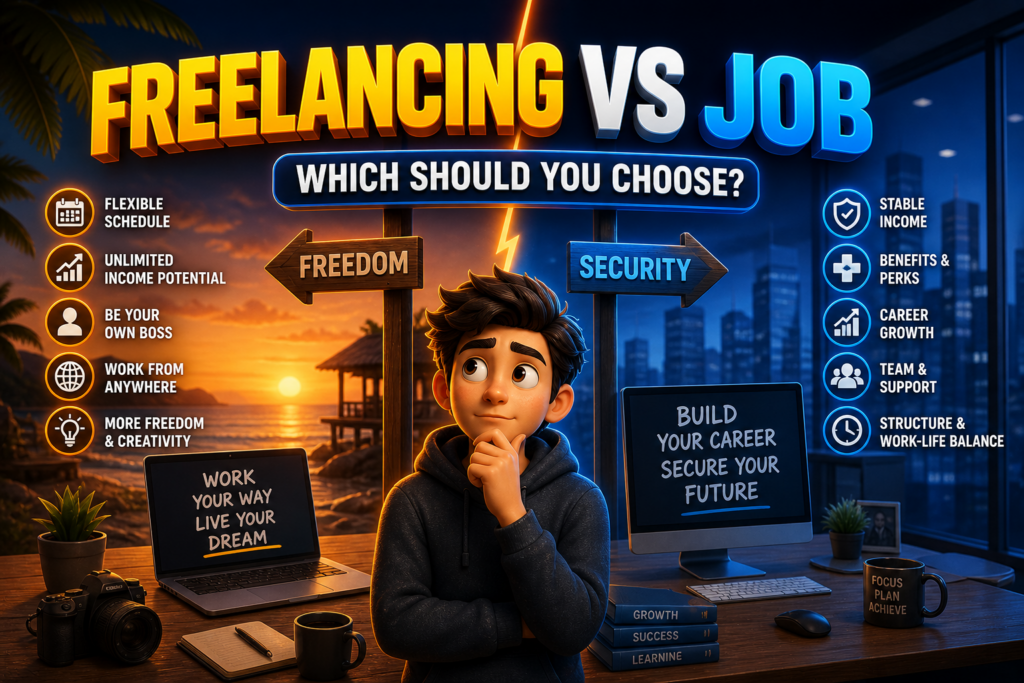
Choosing between freelancing and a traditional job has become one of the most important career decisions in 2026. With remote work, digital platforms, AI tools, and global hiring trends reshaping how people earn, the debate around Freelancing vs Job is more relevant than ever. Both paths offer unique advantages and challenges, and the right choice depends on your lifestyle goals, financial needs, skills, and risk tolerance.
This blog explores both career options in depth so you can make a clear, informed decision about your future.
Understanding Freelancing in 2026
Freelancing refers to working independently for multiple clients rather than being tied to a single employer. Freelancers typically offer services such as writing, graphic design, programming, digital marketing, video editing, consulting, and more.
In 2026, freelancing has evolved significantly due to platforms like Upwork, Fiverr, and Toptal, along with the rise of AI-assisted productivity tools. Many freelancers now operate like small businesses, managing multiple income streams and clients across the globe.
Key Characteristics of Freelancing:
- Flexible working hours
- Remote work from anywhere
- Multiple clients instead of one employer
- Income varies monthly
- Self-managed taxes and benefits
Freelancing appeals strongly to individuals who value independence and flexibility over stability.
Understanding a Traditional Job in 2026
A traditional job refers to working full-time or part-time for a company with a fixed salary, job role, and structured responsibilities. Even in 2026, jobs remain the most common employment model worldwide, although hybrid and remote roles have become more common.
Key Characteristics of a Job:
- Fixed monthly income
- Structured working hours
- Employee benefits (insurance, paid leave, retirement plans)
- Career growth within an organization
- Less responsibility for client acquisition
Jobs provide stability and predictability, which is important for long-term financial planning.
Freelancing vs Job: Income Comparison
One of the biggest differences in Freelancing vs Job is income structure.
Freelancing Income
Freelancers can potentially earn more than salaried employees, especially once they gain experience and build a strong client base. However, income is inconsistent. One month could be highly profitable, while another may be slow.
Factors affecting freelance income:
- Skill level and expertise
- Number of clients
- Market demand
- Negotiation skills
- Personal branding
Job Income
Jobs offer a predictable salary every month. Salary increments happen annually or based on performance reviews. While income growth may be slower compared to freelancing, it is stable and reliable.
Conclusion on Income
- Freelancing = High earning potential but unstable
- Job = Stable income but limited initial growth
Work-Life Balance: Which Is Better?
Work-life balance is another major factor in the Freelancing vs Job debate.
Freelancing Work-Life Balance
Freelancers have the freedom to choose when and where they work. This flexibility allows them to travel, spend time with family, or work during their most productive hours. However, freelancing can also blur the line between personal and professional life. Deadlines, client demands, and inconsistent schedules may lead to overworking.
Job Work-Life Balance
Jobs offer fixed schedules, typically 8–9 hours a day. After work hours, employees are usually free. However, office stress, commuting, and strict schedules may limit personal flexibility.
Conclusion on Balance
- Freelancing = Flexible but sometimes chaotic
- Job = Structured but less flexible
Job Security and Risk Factor
Freelancing Risks
Freelancing carries higher risk because there is no guaranteed income. Clients may come and go, and market demand may change. Freelancers must constantly upgrade skills and find new work.
Job Security
Jobs offer higher stability. Even in uncertain economic conditions, employees often have contracts, severance benefits, and structured layoffs.
Conclusion on Security
- Freelancing = High risk, high independence
- Job = Low risk, stable environment
Skill Development Opportunities
Freelancing Skill Growth
Freelancers often learn faster because they work on diverse projects across industries. They develop business, communication, and technical skills simultaneously. However, they must self-learn and stay updated with market trends.
Job Skill Growth
Jobs provide structured training, mentorship, and professional development programs. However, skill exposure may be limited to one industry or role.
Conclusion on Skills
- Freelancing = Fast, diverse learning
- Job = Structured, specialized learning
Career Growth in 2026
Freelancing Career Path
Freelancers grow by increasing their rates, building personal brands, and scaling into agencies or digital businesses. Success depends heavily on reputation and networking.
Job Career Path
Jobs offer promotions, leadership roles, and promotions within company hierarchy. Career growth is predictable but often slower.
Conclusion on Career Growth
- Freelancing = Unlimited but self-driven
- Job = Structured but limited by hierarchy
Financial Stability and Planning
Freelancers
Freelancers must manage their own taxes, insurance, retirement savings, and emergency funds. Financial planning becomes crucial because income fluctuates.
Job Employees
Employees receive benefits like PF, health insurance, bonuses, and paid leaves. Financial planning is easier due to predictable income.
Conclusion
- Freelancing requires strong financial discipline
- Jobs provide built-in financial safety nets
Technology and AI Impact in 2026
AI and automation have significantly changed both freelancing and jobs.
Impact on Freelancing
Freelancers now use AI tools for writing, design, coding, and marketing. This increases productivity but also raises competition.
Impact on Jobs
Many traditional roles have been automated or restructured. However, companies now focus more on hybrid and digital skills.
Overall Trend
Both freelancers and job holders must continuously upgrade their skills to stay relevant in the AI-driven economy.
Which One Gives More Freedom?
Freedom means different things to different people.
Freelancing Freedom
- Work from anywhere
- Choose clients
- Set your schedule
- No boss authority
Job Freedom
- Fixed responsibilities
- Less decision-making pressure
- Clear boundaries between work and personal life
Conclusion
Freelancing offers more control over lifestyle, while jobs offer mental relief from business responsibilities.
Pros and Cons Summary
Freelancing Pros
- High earning potential
- Flexible schedule
- Location independence
- Diverse projects
Freelancing Cons
- Income instability
- No employee benefits
- Self-management burden
- High competition
Job Pros
- Stable income
- Employee benefits
- Career structure
- Less financial risk
Job Cons
- Limited flexibility
- Fixed salary growth
- Office politics
- Less independence
Freelancing vs Job: Which One Should You Choose in 2026?
There is no universal answer to the Freelancing vs Job question. The right choice depends on your personality, goals, and life situation.
Choose Freelancing If:
- You value independence
- You are self-disciplined
- You want unlimited earning potential
- You enjoy working on different projects
- You are comfortable with risk
Choose a Job If:
- You prefer stability
- You want fixed income
- You need financial security
- You like structured environments
- You want long-term corporate growth
Hybrid Approach: The Future Trend
In 2026, many professionals are choosing a hybrid model—keeping a job while freelancing part-time. This approach offers the best of both worlds:
- Stable income from job
- Extra earnings from freelancing
- Skill diversification
- Reduced financial risk
This trend is growing rapidly, especially among young professionals and digital workers.
Final Thoughts
The debate around Freelancing vs Job is not about which is better universally, but which is better for you. Freelancing offers freedom, creativity, and unlimited potential, while jobs offer stability, structure, and security.
In 2026’s fast-changing digital economy, success comes from adaptability. Whether you choose freelancing, a job, or both, continuous learning and skill development will define your long-term success.
Your decision should align with your personal goals, not societal pressure. Both paths can lead to financial success and career satisfaction if chosen wisely and pursued with dedication.